Skip to content

For expat parents in Germany

Having a baby in Germany? Here's what to do, and when.

Elterngeld, Kindergeld, Hebamme, Kita and your baby's passport, explained in plain English and in the order you'll need them. Written by an expat mum who went through all of it in 2026.

✓ Free guides   ✓ Plain English   ✓ Checked October 2026

Your first 4 weeks, at a glance

Worth saving as a screenshot.

  1. 1

    Within 7 days: register the birth

    Standesamt → Geburtsurkunde (ask for extra copies).

  2. 2

    Add baby to health insurance

    Send the birth certificate to your Krankenkasse.

  3. 3

    Wait for the Steuer-ID letter

    It arrives by post automatically. You need it for Kindergeld.

  4. 4

    Apply: Kindergeld + Elterngeld

    Elterngeld is only paid 3 months back — don't wait.

📊 Your baby today

Short, clear and practical

Most of us read this on a phone, in between feeds. So every guide is short, starts with a checklist, and tells you which office, which form and which deadline.

🗂️

Deadlines first

Time-critical steps come first, so you don't miss a deadline that costs you money.

🇩🇪

German terms explained

We keep the German word you'll see on the form and explain what it means.

🪔

Two cultures, one family

OCI cards, visas for your parents, postpartum food, and raising children between two cultures.

🤝

A community

No family nearby? Meet other parents, share tips, and use templates that save you time.

Mini-game

Expat Parent Survival Bingo 🎲

Tap every square you've been through. Four in a row is a bingo. Then share your score with friends.

My German Parenting Score

Just landed

0/16 squares · 0 bingos

Share on WhatsApp 💬

Saves on this device. Shuffle for a fresh card anytime.

One short email a week.

Deadline reminders, rule changes and one practical tip. You also get our free "First 30 Days" checklist when you join.

Mom & Dad

Looking after you, not just the baby

Healthcare, your Hebamme, maternity leave and money. Getting these four sorted early makes the first year much easier.

🩺 Healthcare during pregnancy & after

Your Mutterpass

Your Frauenarzt/Frauenärztin issues this blue booklet at the first confirmed check. Carry it everywhere from week 30 — the hospital will ask for it.

Register at the clinic

Most hospitals want an Anmeldung zur Geburt around weeks 30–36. Book a Kreißsaalführung (delivery room tour) — many run in English on request.

Public vs private insurance

In public insurance (GKV), your baby can usually be co-insured for free (Familienversicherung). If one parent is privately insured and earns above the threshold, the rules change — check before birth.

Mental health matters too. Postpartum low mood is common and treatable. Tell your Hebamme or GP — and if you ever feel unsafe, call 112 or the free Telefonseelsorge on 0800 111 0 111 (24/7).

🤲 Your Hebamme (midwife): start looking now

In Germany, a Hebamme visits you at home after birth — checking healing, feeding, weight and your mood. Public insurance covers it. It's one of the best parts of having a baby here. The catch: in many cities midwives are booked months ahead, so start looking as soon as you know you're pregnant.

✅ Your Hebamme search plan

  • • Week 6–12: start contacting midwives as soon as pregnancy is confirmed.
  • • Use your city's Hebammensuche / Hebammenzentrale and your Krankenkasse's search tool.
  • • Email 10–15 at once — replies are slow; it's normal, not rude.
  • • Ask specifically for Wochenbettbetreuung (postnatal home care).
  • • Still nothing at 30 weeks? Ask your clinic about a Hebammensprechstunde or ambulatory midwife clinic.

✉️ Copy-paste email (German)

Betreff: Anfrage Wochenbettbetreuung – ET [TT.MM.JJJJ]

Liebe Frau [Name],

ich bin in der [X]. SSW, mein errechneter Termin ist der [Datum]. Ich wohne in [PLZ, Stadtteil] und suche eine Hebamme für die Wochenbettbetreuung. Ich spreche Englisch und etwas Deutsch.

Hätten Sie noch Kapazitäten? Ich freue mich über eine kurze Rückmeldung.

Viele Grüße
[Name], [Telefon]

🛡️ Mutterschutz (maternity protection)

6 weeks

before the due date. You may choose to keep working.

8 weeks

after birth — a strict ban on work. 12 weeks for premature births, multiples, or a diagnosed disability in the baby.

~100%

of your average net pay, via Mutterschaftsgeld from your Krankenkasse plus your employer's top-up.

  • • Tell your employer you're pregnant once you're comfortable — protection against dismissal (Kündigungsschutz) applies from the start of pregnancy, lasting until 4 months after birth.
  • • Ask your doctor for the Bescheinigung über den mutmaßlichen Tag der Entbindung about 7 weeks before your due date and send it to your Krankenkasse.
  • • Privately insured or self-employed? The rules differ — check with the Bundesamt für Soziale Sicherung and your insurer early.

💶 Elterngeld strategies that actually work

The short version: Elterngeld replaces roughly 65–67% of your net income (min €300, max €1,800/month for Basiselterngeld). Mutterschaftsgeld months count against it — so plan carefully.

OptionHow it worksBest if…
Basiselterngeld12 months for one parent, 14 if both take at least 2. Full monthly amount.One parent stays fully home in year one.
ElterngeldPlus1 Basis month = 2 Plus months at half the amount. Designed for part-time work.You return part-time early, or want payments to last longer.
Partnerschaftsbonus2–4 extra Plus months each if both work 24–32 hrs/week at the same time.You both want a part-time phase together.

⚠️ Rules expats often miss

  • • Paid only 3 months retroactively — apply in the first weeks.
  • • Parents can take Basiselterngeld at the same time for only 1 month, within the first 12 months (births from April 2024).
  • • Income cap: no entitlement if your combined taxable income is above €175,000 (births from April 2025).
  • • Non-EU nationals generally need a residence permit that allows work (e.g. Blue Card, §18 permits). Some permits are excluded — check yours.

🧭 Smart moves

  • • Elterngeld is based on your income in the 12 months before birth (Mutterschutz months excluded) — big raises or tax class changes need to happen early. Ask a tax advisor, timing rules are strict.
  • • Use the official Elterngeldrechner by the Federal Family Ministry to model splits before deciding.
  • • Most states let you apply online via ElterngeldDigital; others need the paper form from your Elterngeldstelle.
  • • Elterngeld is tax-free but raises your tax rate on other income (Progressionsvorbehalt) — set money aside.

Elterngeld rules change frequently. Figures reviewed October 2026; always confirm with your state's Elterngeldstelle.

Baby & Parenting

Your baby's paperwork, checkups and Kita

There's a lot to do in the first months. Here it is in five parts, roughly in the order it comes up. Tick things off as you go; your ticks stay saved on this device.

First-year paperwork checklist

Everything I wish someone had handed me in one list. Do it in any order.

Not started0%

At a glance

1 Birth registered
2 Hebamme & Kinderarzt
3 Money claimed
4 Passport & visa
5 Kita place

Week 1–4

📜 Register your baby

0 of 4

Pregnancy – month 3

🤲 Hebamme and Kinderarzt

0 of 4

Weeks 2–8

💶 Kindergeld, Elterngeld, Elternzeit

0 of 3

Months 1–3

🛂 Passport and residence permit

0 of 2

Months 2–12

🏫 Kita place

0 of 3

Daily tools

📊 Your baby tracker

Sleep & feed log, routine streaks, the monthly view and the U-checkup & vaccination map now live on their own page, one tap away from anywhere on the site.

Open the tracker →

🌱 Month by month: milestones, movement, play & FAQs

Pick your baby's age. For each stage you'll find what to look out for, simple exercises and massage that support those skills, play ideas, and answers to real questions from parents.

🌼 Every baby has their own timeline

Milestones here are things most babies (about 3 in 4) do by the end of that stage. Many do them earlier or later and are perfectly fine. Born before 37 weeks? Use the corrected age (counted from the due date) until about age 2.

🩺 When to talk to your Kinderarzt

If your baby loses a skill they already had, misses several milestones in a stage, doesn't react to sounds, or something just feels off to you. Trust your gut. That's exactly what the U-checkups are for, and you can always ask in between.

Exercises and massage: only when your baby is awake, content and supervised. Stop if they fuss or turn away. Based on public milestone guidance (e.g. CDC "Learn the Signs. Act Early.") and common advice from German Hebammen and Kinderärzte; not a medical assessment.

🛁 Baby bath time: schedule & FAQs

Bathing is often the first thing we worry about, and the first place two cultures meet: oil massage and warm water at home, short baths and "less is more" from German midwives. Here's a simple guide by age, and answers to the questions parents ask most.

Birth – cord falls off

Sponge baths

  • • 2–3 gentle washes a week
  • • Daily: face, neck folds, hands, nappy area
  • • Keep the cord stump dry

Cord gone – 6 months

Short tub baths

  • • 2–3 baths a week
  • • 5–10 minutes, water about 37 °C
  • • Plain water is enough

6–12 months

Part of bedtime

  • • 3–4 baths a week (solids get messy)
  • • Baby sits with support; still never alone
  • • Bath → massage → feed → sleep

1 year +

Daily if you like

  • • Daily is fine if skin stays soft
  • • Mild baby wash for hair and body
  • • Bath toys and play time

⚠️ The one rule that matters most

Never leave your baby alone in the bath, not even for a few seconds to grab a towel or answer the door. Babies can drown in a few centimetres of water, quickly and silently. Get everything ready before you start.

🧺 Bath kit (all at dm, Rossmann or online)

  • • Babybadewanne (baby tub)
  • • Badethermometer
  • • Kapuzenhandtuch (hooded towel)
  • • Soft washcloths
  • • Clean nappy + clothes ready
  • • Optional: Badeeimer (bath bucket)

Bath time FAQs

How often should I bathe my baby?▾

Two or three baths a week is plenty for most babies in the first year. Many German Hebammen suggest even less for newborns. On the other days, wipe the face, neck folds, hands and nappy area with warm water.

Bathing every day is fine if your baby enjoys it and their skin stays soft. If you see dry patches, cut back.

Can I bathe my baby before the umbilical cord falls off?▾

Many midwives recommend a gentle sponge or "top and tail" wash until the stump falls off, usually within 1–3 weeks. Some are fine with short tub baths. Ask your Hebamme what she prefers, and keep the stump clean and dry afterwards.

What water temperature is right?▾

About 37 °C, close to body temperature. A cheap Badethermometer from dm or Rossmann takes the guesswork out. No thermometer? Test with your elbow or the inside of your wrist: it should feel warm, never hot. Keep the room warm too, around 22–24 °C, especially on winter evenings.

Do I need soap or baby shampoo?▾

Not in the first weeks. Plain water is enough. Later, a small amount of mild, fragrance-free baby wash for the nappy area and hair is fine. Skip bubble bath. It dries out young skin.

We do an oil massage before bath, like at home. Is that okay?▾

Yes, a gentle massage is a lovely ritual and many families in India and Germany do it. Points worth knowing:

  • Many paediatricians suggest sunflower or coconut oil. Olive and mustard oil can weaken a newborn's skin barrier.
  • If your baby has eczema or very dry skin, ask your Kinderarzt first.
  • Don't put oil in the ears or nose.
  • An oily baby is slippery. Hold firmly, or wipe off excess oil before the bath.
What about baby powder and kajal?▾

Doctors advise against talcum powder, because babies can breathe in the fine dust. For kajal or surma around the eyes, many traditional products have been found to contain lead, so paediatricians recommend avoiding them. A small black dot behind the ear is a safer way to keep the tradition.

When is the best time of day for a bath?▾

Many parents bathe in the evening as part of a bedtime routine: bath, massage, feed, sleep. Doing the same steps in the same order every night helps babies wind down. Avoid bathing straight after a feed or when your baby is very hungry or overtired.

How long should a bath take?▾

5–10 minutes is enough. Babies lose heat quickly, so wrap them straight away in a hooded towel (Kapuzenhandtuch) and dry the creases well: neck, armpits, behind the ears and the nappy area.

My baby hates bath time. What can I do?▾

Very common. Try a warmer room, a little less water, and a washcloth over the tummy so they feel covered. Some babies calm down in a Badeeimer (bath bucket), where they sit curled up like in the womb. Or bathe together, with a second adult to pass the baby to you and take them out.

What's the flaky, yellowish skin on my baby's scalp?▾

Usually cradle cap (Kopfgneis in German). It's harmless and common. Soften the scales with a little oil before the bath, then brush very gently with a soft baby brush. Don't pick at it. If it spreads, looks red or itches, show your Kinderarzt.

Can I bathe my baby after vaccinations?▾

Yes, in most cases a normal bath on the same day is fine. Just don't rub the injection spot. If your baby has a fever or seems unwell, a quick wash is enough, and call your Kinderarzt if you're worried.

Is our hard German tap water a problem?▾

Tap water in many regions of Germany is hard (calcium-rich), and some parents find it makes their baby's skin drier. Keep baths short, use little or no soap, and apply a plain fragrance-free cream afterwards if needed. If dryness or redness doesn't improve, ask your Kinderarzt.

General guidance only. Your Hebamme and Kinderarzt know your baby best. Ask them about anything specific, especially skin problems, a premature baby or a baby who is unwell.

🏫 The Kita maze, simplified

Every child in Germany has a legal right to a childcare place from their first birthday. In practice, places are scarce in many cities, so it helps to start early and apply widely.

1 · Register everywhere

Use your city's central portal (e.g. Kita-Navigator) if there is one, and contact Kitas directly. In Berlin and Hamburg you'll need a Kita-Gutschein (voucher) from the Jugendamt.

2 · Follow up, kindly

A short, friendly update every 6–8 weeks keeps you visible. Visit open days. Consider a Tagesmutter (childminder) as a bridge — often easier to find for under-3s.

3 · Plan Eingewöhnung

Settling-in takes 2–6 weeks with a parent present (Berlin or Munich model). Don't schedule your return to work the day after the start date.

No place by the time you need it? You can formally claim your Rechtsanspruch with the Jugendamt in writing. Document every application — it matters if you later claim lost earnings.
Get our Kita Email Swipe File →

📊 Your baby tracker

Today at a glance

Private by design: everything is stored only on this device.

📱 Open this like an app: add it to your home screen▾
  • iPhone (Safari): tap the Share button, then "Add to Home Screen".
  • Android (Chrome): tap ⋮, then "Add to Home screen" or "Install app".
  • Add it while you're on this Tracker page, and the icon opens straight here.

😴 Sleep & feed log

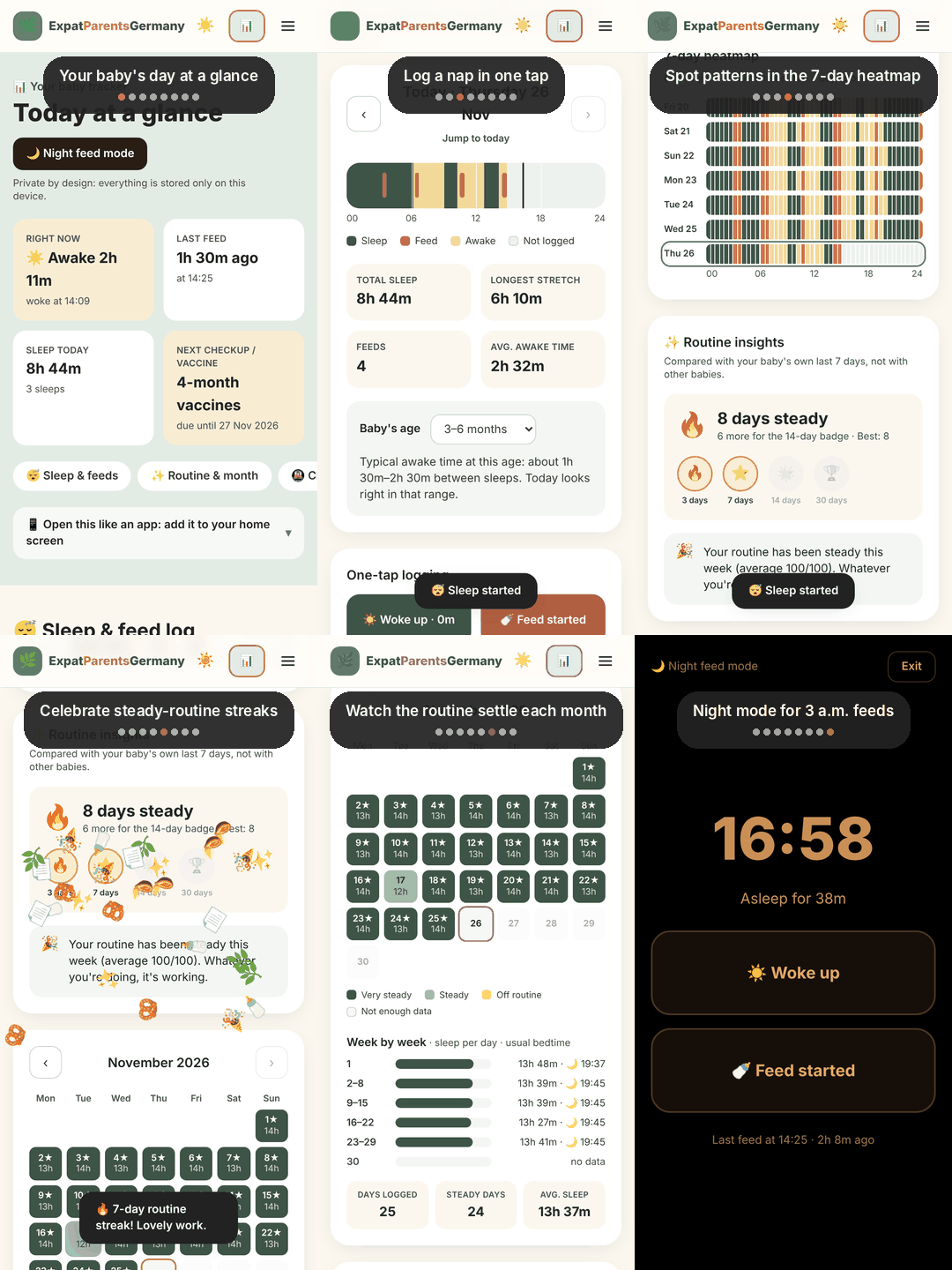
Tap once when your baby falls asleep, wakes up or starts a feed, or add entries later. The colour bar shows the day at a glance, and the 7-day heatmap shows the patterns: nap times, night stretches and how long your baby is awake in between. Everything stays on this device.

Today

Sleep Feed Awake Not logged

One-tap logging

Add an entry

An end time earlier than the start counts as the next morning. Feeds without an end time are saved as 20 minutes.

7-day heatmap

Each square is 30 minutes. Tap a day to open it above.

✨ Routine insights

Compared with your baby's own last 7 days, not with other babies.

    Month

    Very steady Steady Off routine Not enough data

    Week by week · sleep per day · usual bedtime

    Entries for today

      Awake times are rough guides from common paediatric advice. Every baby is different. Watch your baby's tired signs too (yawning, rubbing eyes, looking away). Bring the export to your Kinderarzt or Hebamme if you have sleep or feeding worries.

      🚇 U-checkups & vaccinations map

      All U-checkups (U1–U9, recorded in the yellow Gelbes Heft) and the STIKO vaccination schedule on one line. Add your baby's birth date to see the real dates, and tap a stop to mark it done. Everything stays on this device.

      U-checkup line Vaccination line Done Due now Overdue

        U-checkup windows follow the official Kinder-Richtlinie; vaccinations follow the STIKO calendar for 2026 (the MenC dose at 12 months was dropped in 2026). Dates are a planning aid: your Kinderarzt decides the exact schedule, and some practices combine or shift doses. Bring the Gelbes Heft and the Impfpass to every visit, and book the next U-checkup as you leave.

        💼 Back to work Coming soon

        Job alerts made for mums in Germany

        Remote, hybrid and part-time (Teilzeit) jobs that fit your skills, in your inbox every morning. Each one is scored against your profile, with a short note on why it fits and one tip for applying.

        1. 1Tell us once
          Your skills, the roles you want and how flexible you need to be.
        2. 2We search every morning
          Fresh postings from company sites and major job boards.
        3. 3You apply to the best fits
          Only matches scoring 6/10 or higher. No spam, unsubscribe in one click.

        👯 Twins & multiples

        Twins in Germany: what changes when two arrive at once

        More check-ups in pregnancy, more paperwork afterwards, and a few extra entitlements that make a real difference. Here's what's different for twins, triplets and more, and where to find other parents who've done it.

        💶 Money & leave: what you get with twins

        €518 / month

        Kindergeld: €259 for each child (2026)

        +€300 / month

        Elterngeld supplement for each extra baby

        12 weeks

        Mutterschutz after the birth, instead of 8

        Per child

        Elternzeit for each twin, usable until the 8th birthday

        Elterngeld: one claim, plus a twin supplement

        Each parent has one Elterngeld claim, not one per baby. On top comes the Mehrlingszuschlag: €300 a month for the second baby, and another €300 for each further baby. In ElterngeldPlus months it is halved.

        Already have an older child under 3 (or two under 6)? The sibling bonus of 10%, at least €75 a month, can come on top.

        Elternzeit for each child

        Each parent can take Elternzeit for each twin: up to 3 years per child, counting Mutterschutz. Whatever you don't use before the 3rd birthday can be taken between the 3rd and 8th birthday.

        In practice: take time now for one twin, and save the other twin's Elternzeit for Kita settling-in or school start. Plan it in writing with your employer.

        Mutterschutz: 12 weeks after the birth

        With multiples, Mutterschutz lasts until 12 weeks after the birth. If the twins arrive early, the days you missed before the birth are added on top.

        Send the birth certificate to your Krankenkasse and your employer.

        Kindergeld and household help

        Apply for Kindergeld for both babies. Each gets their own Steuer-ID by post, and each receives €259 a month.

        With two newborns, ask your Krankenkasse about household help (Haushaltshilfe) early, especially after a C-section or if your partner can't take leave.

        🤰 Pregnancy & birth

        More check-ups, earlier planning

        Twin pregnancies are monitored more closely, with more ultrasounds. Pack the hospital bag, buy car seats and plan family visits earlier than the due date suggests.

        Choose the clinic with care

        Many twins arrive before 37 weeks. A hospital with a Perinatalzentrum has a neonatal unit on site, so babies and parents can stay together. Read our born-early guide.

        Work and the Hebamme

        If work gets too much, your doctor can issue a Beschäftigungsverbot (work ban) before Mutterschutz starts, and you keep your full pay.

        Start the Hebamme search early, and tell her straight away that it's twins.

        🍼 Everyday life with two

        Feeding two

        Breastfeeding twins together (tandem feeding) is possible. A twin nursing pillow and a lactation consultant (Stillberaterin) help a lot. Many families combine breast milk and formula: whatever keeps everyone fed and rested is the right plan.

        One rhythm instead of two

        Many twin parents wake the second baby when the first one wakes for a feed. It feels harsh at first, but it often means longer breaks for you.

        Twin pram and gear

        Side-by-side or tandem? Measure your lift, front door and the doors of your local bus or tram before you buy. You need two car seats from day one.

        Look for twin second-hand sales (Zwillingsbörse or Mehrlingsbörse), and ask shops and baby brands about a Mehrlingsrabatt (discount for multiples).

        Your village

        Meet other twin parents through the ABC-Club e.V. (the German association for twins, triplets and more), local twin meet-ups at Familienzentren, or by pinning a note on our Fridge Door.

        🏫 Kita with twins

        Apply for two places at once

        Say it clearly in every application ("Zwillinge, zwei Plätze ab …"). Two places in the same Kita can be harder to find, so apply widely and consider a Tagesmutter as a bridge.

        Same group or separate?

        There's no right answer. Many Kitas start twins in the same group and decide later. Settling-in (Eingewöhnung) is sometimes done one twin after the other.

        Fees

        Sibling discounts (Geschwisterermäßigung) vary by city and state, and in some states Kita is free anyway. Ask your Jugendamt. Kita fees also count in your tax return: see our tax hack.

        🛂 Paperwork x2 (for Indian and other non-German families)

        • Two birth certificates: order 3–4 multilingual copies for each baby.
        • Two Steuer-IDs, two Kindergeld entries, two Krankenkasse registrations.
        • Non-German babies: two residence permits, both within 3 months of the birth.
        • Two passports or two OCI applications. Book a slot for each baby, or ask whether one appointment can cover both.
        • Grandparents visiting? Twins often arrive early, so plan the visa and flights earlier.

        ❓ Twins FAQs

        Do we get double Elterngeld for twins?▾

        No. Each parent has one Elterngeld claim. What you get on top is the twin supplement: €300 a month for each extra baby (half in ElterngeldPlus months).

        Can both parents take Elternzeit at the same time?▾

        Yes, Elternzeit can overlap. For Elterngeld, though, parents can only receive Basiselterngeld at the same time for one month within the first 12 months (births from April 2024).

        Are twins more likely to be born early?▾

        Yes, many twins arrive before 37 weeks. If yours did, you may get extra Elterngeld months and longer Mutterschutz. See the born-early guide.

        Do twins have separate checkups and vaccinations?▾

        Yes. Each baby has their own Gelbes Heft and Impfpass. Ask the practice to book both babies back to back.

        Where can we meet other twin parents?▾

        The ABC-Club e.V. lists local groups across Germany. Many Familienzentren run twin meet-ups, and our Fridge Door has a Playdates & Chai corner.

        General information, checked November 2026. Amounts and rules change: confirm with your Elterngeldstelle, Familienkasse and Krankenkasse.

        🌱 Born early

        When your baby arrives early

        If your baby was born before 37 weeks, the first days or weeks may be spent in the neonatal unit (the "Neo"). It's a lot to take in, especially far from family. Here's what's different in Germany, the extra support you're entitled to, and how to look after yourself too.

        🧮 Corrected age & your extra entitlements

        Enter the birth date and the due date from the Mutterpass. You'll see your baby's corrected age, any extra Elterngeld months, and roughly when Mutterschutz ends.

        Saved only on this device.

        🏥 In the neonatal unit

        Skin-to-skin (Känguruhen)

        Holding your baby on your bare chest helps with breathing, warmth and bonding. Ask the nurses when you can start. Most units encourage it every day, for both parents.

        Pumping breast milk

        Start pumping as soon as you can, even tiny amounts of colostrum matter. Ask the doctor for a prescription (Rezept) for a hospital-grade breast pump. With a medical reason, your Krankenkasse usually covers the rental from a pharmacy. Ask for the unit's lactation consultant too.

        Staying with your baby

        If the hospital confirms it's medically necessary, your Krankenkasse pays for your stay and meals as a Begleitperson, or up to €45 a day for a room nearby if the hospital has none.

        Working parents can get Krankengeld while staying with a child under 12. Ask the ward's social service (Sozialdienst) to help with the forms.

        Words you'll hear on the ward

        Neo / Neonatologie
        neonatal unit (NICU)
        Inkubator
        incubator
        Känguruhen
        skin-to-skin on your chest
        Sättigung
        oxygen level in the blood
        Magensonde
        feeding tube
        Apnoe / Bradykardie
        pause in breathing / slow heart rate
        Visite
        daily ward round with the doctors
        Entlassung
        discharge (going home)

        Getting the most out of the ward round

        • Keep a notebook on the ward and write questions down as they come.
        • Ask the team to explain numbers and plans in English if you need to; many can.
        • You can ask for an interpreter for important talks, for example about discharge.
        • Ask what the next small goal is (feeding, weight, breathing). It makes the long days easier to follow.

        💶 Money & leave

        Extra Elterngeld months

        Born early, you get extra months of Basiselterngeld, based on the gap between the due date in the Mutterpass and the birth:

        • at least 6 weeks early: +1 month
        • at least 8 weeks early: +2 months
        • at least 12 weeks early: +3 months
        • at least 16 weeks early: +4 months

        Applied before the birth? Tell the Elterngeldstelle the real birth date and re-plan your months.

        Longer Mutterschutz

        If the birth counts as medically premature (for example a birth weight under 2,500 g), Mutterschutz lasts until 12 weeks after the birth instead of 8.

        Either way, the days of Mutterschutz you missed before the birth are added on afterwards. Send the hospital certificate to your Krankenkasse and employer.

        Older children at home?

        If you're staying in hospital and nobody can look after your other children, your Krankenkasse may pay for household help.

        Kindergeld and paperwork

        Everything else runs as for any newborn: Standesamt within 7 days, then Krankenkasse, Kindergeld and Elterngeld. The hospital often helps with the birth registration. See the newborn checklist.

        🏡 Going home

        Free support at home (sozialmedizinische Nachsorge)

        Specialist nurses and social workers (for example from a Bunter Kreis) support you after discharge: 6 to 20 hours, at least 3 of them at home, usually within 6–12 weeks.

        The hospital doctor prescribes it, or your Kinderarzt up to 6 weeks after discharge. Your Krankenkasse must approve it before it starts, so ask before you go home.

        Vaccinations and checkups

        Vaccinations follow your baby's actual age, with one extra dose at 3 months for babies born before 37 weeks. Our checkups & vaccines map has a "born early" option.

        Ask the Neo team about RSV protection before discharge, especially in autumn and winter.

        Development follow-up

        Milestones are judged by corrected age until about age 2. Very early babies are often invited to follow-up checks, for example at a Sozialpädiatrisches Zentrum (SPZ). If your baby needs extra support, early intervention (Frühförderung) is free for families.

        Your Hebamme and the first winter

        Tell your Hebamme the discharge date so she can plan home visits. In the first winter, keep visitors with colds away and ask everyone to wash their hands, especially relatives arriving after a long flight.

        🫶 Your feelings matter too

        Shock, worry, guilt or numbness are common after an early birth, sometimes only weeks later, once everyone is home. Many parents also feel they "missed" the end of pregnancy. Talk about it with your partner, your Hebamme or the ward team.

        • Ask the hospital about a psychologist or the social service (Sozialdienst).
        • The Bundesverband "Das frühgeborene Kind" e.V. offers information and parent groups across Germany.
        • Far from family? Pin a note on our Fridge Door. Other preemie parents are often the best listeners.
        • If you feel low for weeks or can't cope, talk to your doctor. You can call the free Telefonseelsorge any time on 0800 111 0 111, and 112 in an emergency.

        ❓ Born-early FAQs

        When will my baby catch up?▾

        Many preemies catch up in growth and development by about 2 years corrected age. Very early babies may take longer, which is why the follow-up checks matter. Compare your baby with their corrected age, not with babies born on the same day.

        When do we start solid food?▾

        Usually by corrected age and readiness signs (sitting with support, interest in food), not by actual age alone. Ask your Kinderarzt or the Neo team for your baby's plan.

        Can we fly to India with our preemie?▾

        Ask your Kinderarzt first. Many recommend waiting until the first vaccinations are under way and avoiding the first RSV and flu season. Your baby also needs a passport or OCI and, if not German, a residence permit.

        My baby came home on special milk or a fortifier. Is that normal?▾

        Yes. Some preemies get breast-milk fortifier or a special preterm formula for a while after discharge. Follow the plan from the Neo team and your Kinderarzt, and ask before changing it.

        Could my baby get a Pflegegrad (care level)?▾

        Babies with ongoing medical needs, such as oxygen at home or tube feeding, can sometimes get a care level, which brings financial support. Ask the hospital's Sozialdienst to help you apply.

        General information, checked November 2026, not medical advice. Your Neo team, Kinderarzt and Krankenkasse know your situation best.

        🇮🇳 Indian Expat FAQs

        Raising a little one far from home

        No family nearby, two cultures to deal with, and grandparents asking why the baby is out on a cold evening. Here are clear answers to the questions Indian parents in Germany ask most.

        ✈️ Bringing parents from India

        Which visa do my parents need to come for the delivery?▾

        A Schengen short-stay (C) visa for visiting family. It allows up to 90 days in any 180-day period. Applications are filed in India through the German mission's appointed visa service centre.

        • • Apply up to 6 months before travel; aim for 8–10 weeks ahead — appointment slots in peak season disappear fast.
        • • Time the 90 days well: arriving ~2 weeks before the due date gives you about 10 weeks of postnatal help.
        • • Need longer? A national visa for a longer stay is rarely granted for family visits — plan two separate trips instead.
        What is a Verpflichtungserklärung, and do I need one?▾

        A formal declaration of financial responsibility you sign at your local Ausländerbehörde, promising to cover your parents' costs during the stay. It's very helpful if your parents' own income or savings look modest on paper.

        • • Book the appointment early — some offices are weeks out.
        • • Bring: passport/residence permit, last 3 payslips, rental contract, proof of living space.
        • • There is a fee (usually around €29). Send the original to your parents by courier; they submit it with the visa application.
        Can my parents use my Krankenkasse while they're here?▾

        No. Visiting parents cannot be co-insured in your German health insurance. They need Schengen travel medical insurance with at least €30,000 cover, valid for the full stay across the Schengen area.

        • • Compare Indian "Schengen travel" policies with German "Incoming" insurance — the latter is often easier to claim on here.
        • • Check age limits and pre-existing condition exclusions (diabetes, BP, cardiac). Many cheap policies exclude these entirely.
        • • Pack prescriptions plus a doctor's letter in English for any regular medicines.

        🍲 Postpartum food & first foods

        Where do I find traditional postpartum ingredients in Germany?▾

        Most staples for traditional postpartum food (dry-ginger and fenugreek laddoos, garlic rasam, carom-seed water, light cumin rice) are easy to find:

        • • Indian/Asian grocers in larger cities, plus several online Indian grocers that ship nationwide (order 3–4 weeks before your due date).
        • • Turkish and Middle Eastern shops: fenugreek, fennel, dried dates, nuts, ghee-like clarified butter (Butterschmalz works for cooking).
        • • German supermarkets / Bioladen: ghee, oats, almonds, jaggery-like Vollrohrzucker.
        • • Edible gum and dry ginger powder are the hardest — bring from India or ask your parents to pack them.

        Note: declare food at customs. Meat and dairy products from India are generally not permitted in luggage — sweets made with ghee/milk can be confiscated.

        Breastfeeding? Herbal galactagogues (like fenugreek supplements) can interact with medications — check with your Hebamme or doctor.

        How do I start Beikost (solids) with Indian food?▾

        German guidance: start solids around 6 months, and not before the start of month 5. Your Kinderarzt will often hand you a German "Beikostplan" starting with vegetable–potato–meat purée — Indian first foods fit well too.

        • • Great first foods: smooth moong dal and rice, ragi porridge, mashed sweet potato, pumpkin, carrot.
        • • Iron matters most: vegetarian babies need iron-rich foods daily — dal, ragi, iron-fortified cereal — paired with vitamin C (fruit purée) for absorption.
        • • Spices: a pinch of cumin, turmeric or asafoetida is fine; skip chilli early on.
        • • No salt or sugar added in year one; no honey before 12 months.
        • • A little ghee is fine and adds healthy calories.
        • • Vegan family? Infant diets need medical guidance (B12, iron, iodine, DHA) — tell your Kinderarzt.

        🛂 Registering your newborn: Germany + India

        Does my baby get an Indian passport or an OCI card?▾

        It depends on whether your baby automatically becomes German at birth. India doesn't allow dual citizenship, so:

        → Indian passport

        Both parents Indian, and neither qualifies for the German birthright rule below. Baby is Indian only.

        → German passport + OCI

        One parent is German, or one Indian parent has lived lawfully in Germany for 5+ years with a permanent right of residence (e.g. Niederlassungserlaubnis) at the time of birth.

        Not sure which applies? The Standesamt will note German citizenship on the birth record if it applies — ask them directly.

        Step by step: Indian passport for a baby born in Germany▾
        1. Get the German birth certificate (international/multilingual version saves translation).
        2. Register the birth with the Indian Embassy (Berlin) or your Consulate (Munich/Frankfurt/Hamburg) — ideally within 1 year to avoid complications.
        3. Apply for the passport via the mission's outsourced service centre: both parents' passports, baby's passport photos (white background), parental consent form, address proof.
        4. Apply for the baby's German residence permit at the Ausländerbehörde within 3 months of birth — you'll need the passport for it, so start early.

        Travel tip: don't book flights to India until both the passport and residence permit (or a Fiktionsbescheinigung) are in hand.

        Step by step: OCI card for a German-citizen baby▾
        1. Apply for the baby's German passport (Reisepass) at the Bürgeramt. The Kinderreisepass was discontinued in 2024.
        2. Complete the OCI application online on the Government of India's OCI portal.
        3. Submit documents via the Indian mission's service centre: baby's passport, birth certificate, Indian parent's passport, photos, signature/thumb impression.
        4. Processing often takes several weeks to a few months. OCI gives lifelong visa-free travel to India.

        Need to travel before OCI arrives? Apply for an e-Visa for the baby as a stopgap.

        🫶 Support, help & dual-culture life

        There's no maid, no family nearby. How do people cope?▾

        By lowering expectations and paying for help where you can. Almost every Indian parent here struggles with this.

        • • Haushaltshilfe via Krankenkasse: public insurance can cover household help after birth in certain situations (e.g. medical need, no other help at home). Ask your doctor for a certificate and apply before you need it.
        • • Freeze-ahead: cook dal, sambar, rasam and dosa batter in bulk in the third trimester.
        • • Cleaning help: hiring a Putzhilfe as a Minijob via the Minijob-Zentrale's Haushaltsscheck is legal, simple, and tax-deductible.
        • • Your village: Indian community WhatsApp groups, temple and gurdwara networks, Krabbelgruppen and Familienzentren in your city.
        • • Split the night: one parent sleeps a protected 5–6 hour block. Rotate.
        How do we raise our child between two cultures (and three languages)?▾
        • • Speak your mother tongue at home. Kita will take care of German — kids pick it up fast. "One parent, one language" works well if you speak different languages.
        • • Video-call grandparents at a fixed daily time — routine builds the bond.
        • • Celebrate both calendars: Diwali and Laternenfest, Holi and Fasching. Bring diyas or rangoli into Kita — teachers usually love it.
        • • Tell your Kita about dietary needs in writing (vegetarian, no beef, no egg). Most handle this well.
        • • Expect relatives to question German habits (babies napping outside in the cold, early Kita). It's okay to explain kindly and still do what works for your family.
        Important: Visa, citizenship and embassy procedures change often. This page is general guidance, reviewed October 2026 — always confirm with the Indian Embassy/Consulate, the German mission in India, and your Ausländerbehörde.

        Community & Templates

        Templates and community

        Ready-made German emails and trackers, plus a place to meet other expat parents.

        Go to the Fridge Door 🧲 · 2 AM Confessions 🌙

        Members get

        • ✓ Saved checklists across devices
        • ✓ Free starter templates
        • ✓ Q&A threads with other expat parents
        🗂️
        Notion + Google Sheets

        Bureaucracy Tracker

        Every office, form, deadline and document for pregnancy to year one — with automatic deadline dates from your due date.

        ✉️
        German + English

        Kita Email Swipe File

        12 polite, proven German emails: first enquiry, follow-up, waitlist check-in, Gutschein, and the formal Rechtsanspruch letter.

        🛂
        PDF + checklist

        Parents' Visit Planner (India → Germany)

        Visa document checklist, Verpflichtungserklärung prep, insurance comparison sheet and a 90-day stay calculator.

        💶
        Google Sheets

        Elterngeld Month Planner

        Visual month-by-month planner for both parents — Basis, Plus and Partnerschaftsbonus — with rule warnings built in.

        🍲
        PDF

        Indian Beikost Starter Guide

        A 6-week first-foods plan with moong dal rice, ragi and dal recipes, adapted to German supermarket ingredients.

        Free
        🎁
        Bundle · Save 30%

        The Complete Expat Parent Bundle

        All paid templates, plus free lifetime updates whenever German rules change.

        €31 €44Get bundle

        ★ fresh notes daily ★

        The Virtual Fridge Door 🧲

        Pin a note for other parents, like the scraps we used to leave on Orkut. Share a win, a vent or a tip, or find someone nearby for a pram walk. Please be kind.

        ✏️ pin a note
        Be kind · no phone numbers or addresses0/280

        🌙 anonymous · no names · no judgement

        2 AM Confessions

        Share something honest, anonymously. Others can react with 🫂 (hug), 🥨 (German survival) or 😂 (relatable). There are no comments, so it stays a safe space.

        0/240 · posted as "Anonymous parent"

        Going through a really hard time? You're not alone. Talk to your Hebamme or doctor, or call the free Telefonseelsorge any time on 0800 111 0 111. In an emergency, call 112.

        Hi, I'm Sham.

        Indian, in Germany since 2018, and since March 2026 a happy (if slightly sleep-deprived) mum in Stendal, Sachsen-Anhalt. Most days I'm juggling a baby, a dissertation and a pile of German paperwork, trying to catch up on everything at once. Sometimes that feels overwhelming. So I built the site I wished I'd had.

        The 19 days that started all this

        My due date was 29 March. Our baby arrived on 10 March. The plan was simple: my mum would fly in from India before the birth and stay for the first months. Like every Indian mum, she had the laddoos planned. What she didn't have was a flight that would actually land.

        That spring the war turned flights through the Gulf into chaos. My mum was travelling alone and abroad for the very first time. She speaks only Tamil, no English, no German. She got stuck halfway, in Muscat, and her flight was rerouted again and again.

        So there I was, days after giving birth, on hold with Qatar Airways over and over. The only number that worked was their international customer care line, and I was on an O2 prepaid SIM. Those calls cost me about €300.

        1. India → Muscat

          Mum's first trip abroad, alone. Stuck mid-way while flights were rerouted again and again.

        2. Many hours on hold

          International hotline + prepaid SIM = about €300 in calls, with a newborn on my chest.

        3. Muscat → Munich

          We finally got her onto a shorter flight. No wheelchair waiting for her at Munich airport.

        4. One night in Munich

          Friends picked her up, fed her, let her sleep, and walked her onto the train the next morning.

        5. Munich → Stendal

          A Deutsche Bahn delay of four hours, of course. Then, finally, Amma held her grandchild.

        The friends who became family

        While Amma was still somewhere between Muscat and Munich, my dearest friends here simply showed up. That first week after the delivery, they brought us meals, sat with us, and even took turns burping the newborn so I could rest for a few minutes. I have never felt so blessed. Far from home, with no family around yet, they were our family.

        We all need friends like these: the ones in Munich who got my mum onto the right train, and the ones at home who brought food and took the baby so I could breathe. As expats, we often don't have family nearby to lean on. That's why I'm building a community here, not just a website.

        Then real life started

        • A name in two days. In India we take our time and check astrology before naming a baby. Here, with birth registration due within a week, we picked a name in two days. (I later learned you can give the first name up to a month after the birth. More on that below.)
        • Elterngeld got complicated. My work contract ended in November 2025. I got Arbeitslosengeld in December, January and part of February, then Mutterschutz started mid-February. Every one of those changes how Elterngeld is calculated, and no official page explains it for people in my situation. So I'm writing that guide.
        • Team of two, some weeks. I have a very busy husband who isn't home for at least a week every month. On those weeks it's just me and the baby, and we've become a pretty good little team.
        • A dissertation in the middle of it all. I'm a PhD researcher, and I'm supposed to be writing my dissertation right now. Between feeds, naps and paperwork, I'm always trying to catch up, and some days the writing just doesn't happen. What's helping me get back on track isn't more willpower, it's a system: one tracker for every deadline, templates for the emails I kept rewriting, and lists so my head doesn't have to hold everything. That's exactly why this site has trackers and templates. They're the tools that help me keep everything moving, and I hope they do the same for you.
        • Month six is the real test. We had family help for the first three months and I thought the hardest part was over. Then the baby got mobile. From six months on, they need eyes on them all the time, and that's exactly when the help had gone home.
        • My body. I gained 20 kg in pregnancy and I'm slowly finding my way back, mostly through very long pram walks around Stendal.
        • Looking for our people. We're a happily multilingual family in a lovely small town where expat parents are still rare. Berlin has a hundred meetups. Stendal has me, and I'd love to meet you.

        Mommy brain is real. Here's what keeps me on track.

        I used to keep a whole research project in my head. Now I sometimes walk into a room and forget why I'm there, and that's okay. Mommy brain is real. What helps is building simple systems around it.

        Every item gets a home

        Passports, the Gelbes Heft, nappies, the Elterngeld folder. If something has no fixed place in your home, it ends up everywhere, and that's when it gets overwhelming.

        Routine is your best friend

        Same order for feeds, naps, bath and bed, every day. Fewer decisions for a tired brain, and in my experience a calmer baby too.

        Discipline, not perfection

        Small habits done daily beat big plans. Ten minutes of paperwork at the same time each day keeps the pile from growing.

        What I'd tell you, from my mistakes

        ✈️ Fly parents in early

        Aim for 3–4 weeks before the due date and buy a flexible ticket. Babies don't read due dates. Visa timing →

        ♿ Book assistance, then re-book it

        Request airport assistance with the airline at least 48 hours ahead, and confirm it again after every rebooking. For trains, book Deutsche Bahn's Mobility Service the day before.

        📞 Don't call hotlines on prepaid

        Before the trip, save the airline's German number and any chat or WhatsApp support. Calling over Wi-Fi with an app costs a fraction of a prepaid international call.

        🗣️ Prepare for a parent with no English

        Give them a printed card in English and German with your address, your number and "I need help, I don't speak German". Have a friend on standby at the arrival city.

        👶 The name can wait a little

        You must register the birth within a week, but German law allows the first name to be given up to one month after the birth. Ask your Standesamt how they handle it.

        💶 Gaps before birth? Get Elterngeld checked

        A contract ending, ALG months or a job change before the birth all affect your Elterngeld. Ask your Elterngeldstelle or a Lohnsteuerhilfeverein before you apply.

        🧸 Plan help for month 6+, not just the first weeks

        If family can only visit once, the crawling and climbing phase may be when you need them most. Ask about a later visit, or line up a Kita, Tagesmutter or babysitter for then. Read the Kita guide →

        Why this site exists

        Confession: as a first-time parent, I turned to ChatGPT every single time, about everything from feeds to forms. I'm guessing you have too. Somewhere between all those late-night questions, I realised we all share the same worries and doubts. So I've brought the answers together in one place: a one-stop guide for the questions you have today, and the ones you don't know you'll have yet.

        Everything here comes from things I lived through, things friends lived through, or things I researched because I had to. When something is my opinion, I'll say so. When a rule changes, I'll update the page and tell you what changed. My PhD has trained me to check sources, and I'd rather tell you "I'm not sure, ask the Jugendamt" than make something up.

        If you're in Stendal, anywhere in Sachsen-Anhalt, or anywhere you're still building your village with a little one: come say hi. Tamil, Hindi, English or broken German all welcome.

        With love,
        Sham
        🤫 You found the hidden page

        Insider hacks for expat parents

        The money, insurance and paperwork tips that most of us learn too late, usually from a German colleague over coffee. All legal, all checked November 2026.

        💶 Money

        Invest the Kindergeld instead of letting it disappear

        €259 a month for 18 years adds up to over €55,000 paid in. Moved into savings or investments automatically, it can grow into a real head start.

        • Set up a standing order the day the first payment arrives, so it never mixes with daily spending.
        • Safe and flexible: a Tagesgeld (instant-access savings) account.
        • Long-term: a low-cost ETF savings plan (Sparplan) on a broad global index, possible from about €25 a month.
        • In the child's name (Junior-Depot): gains are often tax-free thanks to the child's own allowances, but the money legally belongs to the child and is theirs to decide on at 18.
        • In your name: you keep control, with €1,000 of investment income tax-free per parent per year (set a Freistellungsauftrag).

        Good to know: Investments can lose value, and nothing here is financial advice. Investing in Indian mutual funds while you're tax-resident in Germany comes with complicated German tax rules, so talk to a Steuerberater who knows both countries first.

        💶 Money · New

        Frühstart-Rente: €10 a month from the state for your child's pension

        A new state-funded retirement account for children. Status (November 2026): passed by the Bundestag in October; the Bundesrat still has to approve it. The planned start is 1 January 2027.

        • How it works: from age 6 until the 18th birthday, the state pays €10 a month into an investment account for your child's retirement. It's invested only in broad global stock funds.
        • Who gets it first: children born in 2020, backdated to January 2026. Each year after that, the children turning 6 are added, so a baby born in 2026 starts receiving it in 2032.
        • Choose the account: you can open a depot with a bank or provider, or a state standard depot. Running costs are capped at 1% a year. If you don't open one, the money goes into a fund run by the Bundesbank.
        • Topping up: parents, grandparents and others can pay in up to €6,840 a year.
        • The catch: the money is locked until age 65 (it can be moved into a private pension contract until age 35). Gains during saving are expected to be tax-free, but the payout taxed.

        Good to know: because the money is locked until 65, it doesn't replace saving for school, university or a first home. Keep a flexible savings plan for that (see the Kindergeld hack). Details such as how parents open the account aren't final yet. We'll update this card once the law is through. Not financial advice.

        💶 Money

        Plan your tax class before Elterngeld is calculated

        Elterngeld is based on your net income. For married couples, the parent who takes the longer Elterngeld often gets more if they are in tax class III before the birth.

        • The new tax class only counts if it applied for at least 7 months of the period Elterngeld is based on, so switch early in the pregnancy.
        • You change it online via ELSTER or with a form at the Finanzamt.
        • It changes your monthly payslips, not the total tax for the year, which is settled in your tax return.

        Good to know: Timing rules are strict and it doesn't pay off for every couple. Run the numbers with the official Elterngeldrechner, and ask a Steuerberater or Lohnsteuerhilfeverein.

        🧾 Taxes

        Get Kita fees and cleaning help back from the tax office

        Two deductions that many expat families miss in their tax return.

        • Childcare costs: 80% of Kita, Tagesmutter or babysitter costs, up to €4,800 per child per year, count as Sonderausgaben.
        • Pay by bank transfer, never cash, and keep the invoices.
        • Household help: 20% of the cost of household services (like a cleaner) comes straight off your tax bill, within yearly limits.
        • File a tax return: the Finanzamt also checks automatically whether the child allowance (Kinderfreibetrag) saves you more than Kindergeld.

        Good to know: Meals at the Kita aren't deductible, only the care itself. Amounts checked November 2026.

        🩺 Insurance

        A 3-week Mutter-/Vater-Kind-Kur, paid by your Krankenkasse

        Not a spa holiday, but the closest thing parents get: a medical prevention or rehab stay at a clinic, with your child, for parents who are run down.

        • Who it's for: exhaustion, constant sleep deprivation, back pain, low mood, or the strain of caring alone. Fathers can apply too.
        • Your doctor fills in the medical form showing why you need it; then you apply to your Krankenkasse.
        • You pay €10 a day as an adult; the child usually comes along.
        • Free counselling centres (search "Müttergenesungswerk Beratungsstelle") help with the application.

        Good to know: If it's rejected, you can appeal (Widerspruch) within a month. Many approvals happen on appeal. It must be medically justified, so be honest about how you're doing.

        🩺 Insurance

        Free postnatal courses and money back for yoga or Pilates

        Your Krankenkasse pays for more than doctor visits.

        • Rückbildungskurs (postnatal recovery) with a Hebamme is fully covered: about 10 hours, starting by the end of the 4th month after birth.
        • Prevention courses: most Krankenkassen pay back a large share of certified yoga, Pilates, back or relaxation courses, often twice a year. Look for "zertifizierter Präventionskurs".
        • Before the birth, compare Krankenkassen extras: some pay for osteopathy, the midwife on-call fee or a baby bonus.

        Good to know: Check your Krankenkasse's bonus programme too. Many pay cash or vouchers for U-checkups, vaccinations and courses.

        🏠 Help at home

        Haushaltshilfe: household help paid by your Krankenkasse

        If pregnancy or birth means you can't run the household, for example after a C-section, complications or twins, and nobody else in your home can, your Krankenkasse can pay for help.

        • Ask your doctor or midwife for a certificate (Bescheinigung) stating why you need help and for how long.
        • Apply to your Krankenkasse before the help starts if you can.
        • Help can come from a care service. Relatives or friends can help too, but usually only their travel costs or lost earnings are paid.
        • Separate rule: if a parent is ill or in hospital and a child under 12 is at home, help can also be covered.

        Good to know: This is especially valuable for expats without family nearby. Ask early, ideally before the birth.

        🏠 Help at home

        Hire a cleaner the legal (and tax-smart) way

        Registering a cleaner as a Minijob in a private household is simple, cheap and insures them in case of accidents.

        • Register via the Minijob-Zentrale using the "Haushaltsscheck".
        • Contributions for household Minijobs are low, and the Minijob-Zentrale collects them for you.
        • 20% of the costs comes off your tax bill (up to €510 a year for a Minijob).

        Good to know: Paying cash "off the books" means no accident insurance for them and no tax refund for you.

        ✈️ Family visits

        Use a real flight reservation, not a "dummy ticket"

        German visa checklists usually ask for a flight reservation, not a paid ticket. You don't need to risk the full fare before the visa is approved.

        • Book a refundable or flexible fare, and cancel or change it if needed.
        • Or use an airline's paid "hold my fare" option, if available on your route.
        • Or ask a travel agent for a real, verifiable reservation with a booking reference (PNR).
        • Buy the final ticket once the visa is approved.

        Good to know: Avoid websites selling fake "dummy tickets". A booking that can't be verified can be treated as a false document and lead to a refusal that stays on record.

        ✈️ Family visits

        Pick visa insurance that refunds you if the visa is refused

        Your parents need Schengen travel insurance (at least €30,000 cover) before the appointment, but the visa might still be refused.

        • Choose a policy that refunds the premium if the visa is refused, and keep the refusal letter.
        • Check the age limits and the rules on pre-existing conditions (diabetes, blood pressure) very carefully.
        • German "Incoming" insurers are often easier to claim with here than policies bought in India.

        Good to know: Pack prescriptions and a doctor's letter in English for any regular medicines.

        🛍️ Everyday

        Kids travel free on trains, and libraries lend toys too

        Small savings that add up every month.

        • Children under 6 travel free on Deutsche Bahn. Ages 6–14 travel free with a parent or grandparent if they're listed on the ticket.
        • Local transport rules vary by city, but under-6s usually ride free.
        • A Stadtbibliothek card is often free for children. Many libraries lend board books, games and even Tonies.
        • Second-hand: Kleinanzeigen and local "Kinderkleiderbasar" or "Babybasar" sales (often at churches or Kitas) for clothes and gear.
        • Drugstore baby clubs (dm, Rossmann) send coupons and samples.

        Good to know: Check car seats and cots carefully before buying second-hand. Ask about accidents and check expiry dates.

        🗓️ Time

        Save some Elternzeit for later

        Each parent can take up to 3 years of Elternzeit, but you don't have to use it all before your child turns 3.

        • Up to 24 months can be taken later, between the 3rd and 8th birthday.
        • Useful for the Kita settling-in period, school start, or a long trip to India.
        • Tell your employer at least 13 weeks before Elternzeit after the 3rd birthday.

        Good to know: Elternzeit (job protection) and Elterngeld (money) are separate. Elterngeld is only paid in the first years, so Elternzeit after the 3rd birthday is unpaid. Plan savings for it.

        Got a hack we missed?

        Pin it on the Fridge Door under "Bureaucracy Battle Scars" or "Desi Expat Hacks". The best ones end up here, credited to you.

        Share a hack →

        General information, not financial, tax, legal or medical advice. Rules and amounts change: check with your Krankenkasse, Finanzamt, Elterngeldstelle or a Steuerberater before acting.